Showing posts with label accessories. Show all posts
| 0 comments ]

Note: These guidelines assume you are interviewing for a professional or office position. Before your interview, it’s always a good idea to try to find out how people at the company, or in that industry, dress on a day-to-day basis—or even better, how you could expect them to dress when interviewing you. This allows you to mirror your interviewers’ style of dress and level of formality, helping to create an unconscious feeling of familiarity and a sense that you belong. But when in doubt, dress up rather than down; such research is primarily useful to avoid the awkwardness of showing up in a suit and tie to meet three interviewers wearing polo shirts and khakis, or vice versa.

1. A solid navy or grey suit, in wool or wool blend, two-button, two-piece, single-breasted, notch-lapel. Any other pattern serves no substantive benefit and may in fact be distracting; pinstripes may be seen as flashy, as would peak lapels on a single-breasted suit. And, as Morgan Freeman noted in The Dark Knight, "Three buttons is a little nineties, Mr. Wayne." In terms of colour, navy and grey are the most conservative; however, black is becoming more common, and if it meets all the other criteria, a black suit will be acceptable for any but the most conservative occupations.

2. A white shirt with a plain point or moderately-spread collar (not button-down). People wearing white shirts are perceived as more trustworthy than those wearing any other colour. However, if you have extremely yellow teeth or extremely pallid skin, solid light blue serves as a good second choice, because it works with any colour of suit and virtually any tie. These are the two shirt colours favoured by politicians the world over for their inoffensiveness and versatility, two qualities also desirable to an interviewee. But avoid French cuffs, since they can be perceived as flashy; if you do wear them, choose subtle cufflinks that are at least 1/2", and not more than 3/4", in diameter.

3. A darker, solid-coloured or subtly-patterned tie. The tie should always be darker than the shirt, lest you look like a mafioso. Plain dark red or burgundy is a good choice, as is medium silver-grey. For patterns, a small dot, nailhead, or geometric pattern is safest. And if your tie is striped or patterned, keep it to a maximum of three (ideally only two) colours or shades; anything else risks looking dated. Also avoid large patterns, such as paisley. And NO SATIN. Lastly, ensure that your tie knot is tight, pulled right up to your collar, and not overly large. Check it in the bathroom mirror before you go into the interview (you did arrive 10-15 minutes early, right?).


4. Round-toed black lace-up dress shoes. Note that every single descriptor in this list is essential. If they’re not round-toed, they’ll look dated. If they’re not black, they’ll look flashy. If they’re not lace-up, they’ll look too casual. And if they’re not dress shoes, they’ll just look inappropriate. A plain cap toe (pictured at right) is always a good choice and will never be inappropriate. You can also get away with a small row of perforations across the top of the cap. Wing-tips are a little bit stuffy and not quite as versatile, so try to avoid them.
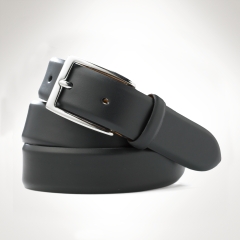
5. A black dress belt, no wider than 1.25 inches. The belt should match your shoes in both its colour and the finish of its leather (i.e. texture and level of shine). Choose a simple prong buckle rather than a plaque or any other design. The tone of the buckle’s metal should match your watch. The choice of silver or gold is up to you, although silver is more current.

6. Socks that match the colour of your pants. Solid or subtly ribbed, in wool or cotton depending on the weather. Not faded; ideally, washed once, inside-out, in cold water. I find that a good percentage of nylon (25-35%) and a small percentage of spandex (5-10%) greatly helps dress socks to stay up properly.

7. No pocket square, unless you’re interviewing with a menswear store, a rapper, or the NBA.

8. A simple, elegant, moderately-sized (less than 35mm in diameter) dress watch, preferably with a leather strap. The colour of the metal and leather should match the other things you're wearing (silver and black, preferably). A plain white face with Roman numerals is ideal. Absolutely no sports watches or *shudder* digital watches.

Generally speaking, no aspect of your outfit should be loud, flashy, or conspicuous in any way. You want to project a general aura of being well-put-together, without any one item drawing attention to itself. People should be left with the impression that you looked good, but not quite be able to put their finger on why. Ideally, your clothes will serve as a backdrop, allowing your non-physical strengths to shine through, but at the same time subtly enhancing your overall appeal—like the setting of a gemstone.

So, you get the job, and then you discover that the dress code is “business casual.” Sweet! Now you’re home free, right?

Well… not quite.

But we’ll talk about that next time.

| 0 comments ]

This past Friday my wife and I visited the Salvation Army Thrift Store in the Kerr Village area of Oakville, a suburb of Toronto known for being full of rich people. I think I can fairly safely say that, at the least, people in Oakville must own really nice stuff, because what they get rid of is pretty amazing:


Each item in the above photo was $1.99, except for the shoes, which were $8.99. I don't often have good luck with clothes at thrift stores, but I can usually find at least one tie that's decent. But finding two that are so perfectly preppy is unprecedented. First we have the very nautical Chubb Marine Underwriters tie, which would look perfect with a blazer:

Silk face, polyester lining, 3 1/8" wide, made in USA.

And then of course we have the game-bird critter tie:

All silk, 3 1/2" wide, made in England.

I'm not completely certain what kind of bird it is, but going by this picture, I'm pretty sure it's a grouse.

But I think I'm probably most excited about the Sebago burgundy tassel loafers:

Leather upper, leather sole, made in USA.
I love tassel loafers, and these will go just perfectly with khakis, navy or grey dress pants - hell, even my white linen/cotton pants. Of course they need a little spit and polish, but there's nothing seriously wrong with them, so they'll clean up very nicely. They look a lot better even after just putting in shoe trees.

And the runner-up for Most Exiciting Item is definitely The Kennedys: Portrait of a Family by Richard Avedon. I actually gasped out loud when I pulled it off the shelf. It features never-before-seen family portraits of the Kennedys taken by Richard Avedon and donated to the Smithsonian before his (Avedon's) death.

Next weekend? The Oakville Value Village!

| 0 comments ]

As a follow-up to my beginner's guide, in this edition I'll share some pointers for fine-tuning your attire, and in particular, how to make your existing clothes look better. In dressing, as with most things, the details often make the difference between glorious, soaring success and dismal, soul-crushing failure.

1. Suppress Your Waist
I've said it before, and I'll say it again: the ideal male body is supposed to have a triangular torso, wider in the shoulders and chest than in the waist. To achieve this ideal shape (or the illusion thereof), a suit jacket should taper inward at the waist, rather than falling straight down from the underarm to the hip. This tapering is known as "waist suppression." Ever wonder why your suits never look as good as movie stars' do? Waist suppression may be the answer (that, and the fact that their suits probably cost 5-10 times as much as ours). Now, many suit jackets, especially the less expensive, don't come this way off the rack, but even if they do, you should engage the services of a tailor to alter the jacket in order to achieve the most flattering shape for your body. Note that, if the fabric of the jacket wrinkles in a pronounced "X" shape when the button is done up, you've got too much waist suppression, and the jacket is too tight. A good rule of thumb is that, when the jacket is buttoned, you should be able to fit your clenched fist inside of it, between your stomach and the fabric—no more, no less.

2. Hem Your Damn Pants

Shoes, Bruno Magli. Pants, After Six.
I couldn't count the number of times that I've seen men with a veritable puddle of excess pant length pooled around their ankles. It makes them look absolutely slovenly! There's really no excuse for this offence; a proper pant hem can be had for $10 or less at every quick-service mall alteration shop in the land. But the key to a perfect hem lies in you, the customer, giving proper and precise instructions. First of all, be sure that you're wearing your dress shoes, i.e. the ones that you'll be wearing most often when you wear the pants. Then, I usually request that the back of the hem fall half an inch above the top of the heel, and also to have the hem angled so that the front is slightly shorter than the back. This keeps the break neat and tidy.*

* Theoretical background: Think of the crease in the front of your dress pant as a straight line, falling from your thigh all the way to your foot. If you had no excess fabric, the pant leg would fall uninterruptedly down, barely touching your shoe, and would flap around your ankle as you walk. A little bit of extra fabric creates a "break" in the line of the crease, and allows the hem of your pant to stay more in contact with your shoe as you walk, minimizing the undesirable "flapping" effect. Too much extra fabric just looks sloppy.

3. Shorten Your Damn Sleeves
Can you tell I'm a little bit frustrated here? Even Conan O'Brien, an otherwise nearly-impeccably-attired man, is guilty of this transgression. In the simplest terms: when you are standing with your jacket on and your arms at your sides, do not allow your jacket's sleeve to entirely cover your shirt's sleeve. The jacket sleeve should be short enough that one-half inch of shirt cuff (or perhaps a smidge less) is visible past the end of the jacket sleeve. Aesthetically speaking, the contrast created by the shirt attracts attention to the hands, one of the only areas of flesh visible when a man is wearing a suit. I also think that without it, jacket sleeves just look too long—as if they're on the verge of falling over your hands. Also, if you're wearing a French-cuff shirt, no one will ever see your cufflinks.

4. Try a Pocket Square
Whether it's a stark Mad-Men-esque strip of pure white linen or a devil-may-care spray of asymmetrical silk points, a pocket square instantly ups the style factor of any outfit. Although they fell out of favour in the nineties (along with just about every other tenet of proper masculine dressing), pocket squares have been back in a big way for the last 5-10 years, and show no signs of going away—at least not as long as Don, Roger, and the gang keep pouring Old Fashioneds. Style gurus often say that your pocket square should be of a different fabric from your tie: a silk tie calls for a linen or cotton square, while a cotton or wool tie necessitates a silk square. I personally don't think it matters that much; actually, I prefer to coordinate the fabrics, to avoid a jarring contrast. However, your pocket square should never match your tie; rather, it should pick up a colour in it, or from another of the elements of your outfit above the waist. If you're feeling foppish, try matching your pocket square to your socks, but be warned that this is an advanced manoeuvre and should not be attempted by amateurs.

5. For Further Festive Frivolity, Fun Footwear Makes Fine Fare
Socks, Polo Ralph Lauren.
 Normally, I don't really like zany socks, especially the multicoloured candy-striped versions I've been seeing on otherwise well-dressed men for the last few years. To me, they seem like a useless trend, an excuse for upscale menswear retailers to charge you $25 or more for something you absolutely don't need. But you can't go wrong with a classic Argyle pattern, like the one on the left. Under no circumstances, however, should it be paired with a suit (I was wearing a blue blazer with those grey pants). On the other hand, a subtle seasonal solid colour, like burgundy or forest green, will go nicely with a either a suit or casual clothes. For an added dash of panache, coordinate the socks with one of your other accessories. This would be a bit over-the-top for business wear, but hey, it's the holidays! Cut loose and have fun.

Slippers, H&M.
If you're feeling even more dandyish, you might try a pair of embroidered velvet slippers. For those who don't own a burgundy velvet smoking jacket, they may be just the thing to add a touch of Hefnerian loucheness to your wardrobe. Perhaps the best-known are made in England by Stubbs & Wootton, but if you're like me, you'll probably find the $400 price tag rather steep for the amount of use you'd get out of them. Instead, consider this pair from H&M, a relative steal at $35 ($30 in the U.S.). Bonus points if your last name starts with a "C." They're not for the faint of heart, but if you want to make a statement (or are going stag to a New Year's party and need an icebreaker), I can't think of a better footwear choice. Just wait until you get inside to change into them, won't you? Road salt is definitely not the kind of stain that you'd expect to find on your clothes after a good party.

| 0 comments ]

Men: do you not know the first thing about dressing up? Ladies: are you sick of your man looking like a schlub? Want to dress better but don't know where to start? Look no further. I've compiled the following list of tips which, taken together, will go a long way towards making you look more like Conan O'Brien and less like Conan the Barbarian. If you're pressed for time (or are just efficient), all you really need to read is the bold-face text, but the subsequent explanations will add context and clarity.

1. Never, EVER button the bottom button of a single-breasted jacket.
Why not? Well, logically speaking, it's because a properly-tailored jacket is designed to flare out slightly at the hips, to give you more room when walking or sitting, so if you try to do up the bottom button, it will be too tight. But illogically speaking, you just don't do it. Period. It's just one of those rules. I didn't make it up; I'm just telling you so that you don't look silly to people who know the rules. (N.B.: For double-breasted jackets, all buttons should always be kept buttoned unless you're sitting down.)

2. The bottom tip of your tie should fall in the middle of your belt buckle.
This isn't always easy to accomplish for shorter men or men with small necks, because we don't tend to use up enough of the tie. The problem can often be solved by using a different tie knot. For most men, the knot they know how to tie—the one they were taught by their dad, or by some chagrined girlfriend 15 minutes before leaving for a semi-formal function—is the four-in-hand. It's a compact knot that forms an asymmetrical (scalene) triangle. Now, if you find yourself with too much tie, try the half-Windsor. It's a slightly more bulky knot that forms a symmetrical (isosceles) triangle. It also uses more of the length of your tie, because you wrap the tie around an extra time before finishing the knot. Result: no more sloppy extra length.

Bonus tip: Always allow yourself a minimum of 10 minutes to tie your tie. This prevents you from feeling rushed when you're getting ready, and gives you enough time to retie several times if you don't get it right the first time (and it will be a miracle if you do).

3. Chinos are not semi-formal, unless you wear them with a jacket.
"Chino" is the generic term for a khaki-style pant (i.e. one made of cotton) that's not khaki-coloured. If you're invited to a holiday party with a semi-formal dress code, wearing chinos with a dress shirt and tie is not good enough. At a minimum, you should wear dress pants. The only exception to this is when you're wearing chinos with an odd jacket (sport coat or blazer).

Bonus tip: An "odd jacket" is any jacket that is not part of a suit, i.e. not worn with trousers made from the same fabric. A "blazer" is a solid-coloured jacket with metal buttons. A "sport coat" is a patterned jacket with plastic, horn, or leather buttons. A solid-coloured jacket with plastic buttons of the same colour as its fabric should not, in most cases, be worn as an odd jacket.

4. Pleated pants don't look good on anyone.
If you're thin, pleated pants add bulk to your thighs and midsection. If you're not thin, pleated pants put more fabric and detailing in the area towards which you least want to draw attention. Flat-front pants look better on everyone, and are always correct.

5. These are not dress shoes.
These are casual slip-ons, and ugly ones at that. A dress shoe is (for the most part) plain, unembellished, simple, and elegant, ideally with a leather sole. If you only have one pair of dress shoes, they MUST lace up. (Some dress shoes are slip-ons, but these are for the most part monkstrap loafers, which are unusual enough that they should really only be your third or fourth pair of dress shoes.)

The following is the prototypical dress shoe, the Park Avenue model by Allen Edmonds:


The piece of leather across the toe part of the shoe is called a "cap toe." Plain black cap-toe laceups such as these are perfect for any formal or semi-formal occasion. They can be bought for less than $100 by manufacturers such as Florsheim and Bostonian. Please invest in a pair. If you only wear them a few times a year, they'll last a long time, and they'll never go out of style.

Bonus tip: Buy shoe trees as well. Shoe trees are spring-loaded pieces of cedar carved in the shape of feet, which you put into dress shoes while you're not wearing them so that they maintain their shape and don't crease too much where your foot bends. A $20 investment in a decent pair of shoe trees will dramatically extend the life of your shoes.

6. Nor are these dress socks.
The same socks that you'd wear with jeans or other casual pants are absolutely not acceptable for semi- or formal wear. You need dress socks, which are very thin, because they are designed not to interfere with the close fit of dress shoes. They are usually made of cotton, wool, or a rayon blend. (I personally swear by Calvin Klein socks, which can be gotten fairly cheaply at your local Winners/TJ Maxx/Marshalls/TK Maxx.) If you've never worn dress socks before, you may imagine at first that they feel like pantyhose. This feeling will go away. Please note that you should match the colour of your socks to your pants, not your shoes.

Bonus tip: Always wash dress socks inside-out in cold water to prevent fading.

7. A dress shirt collar is supposed to fit snugly.
This is so that, when you button the top button and put on a tie, there won't be a gap between the collar and your neck. If there is a visible gap between your collar and your neck anywhere around the circumference, your collar is too big. You should be able to fit two fingers in between the shirt and your neck, and that's all. If you want to be sure of a correct fit, have a friend take a flexible sewing tape measure and measure around your neck where a shirt collar would be. Note the measurement to the nearest half-inch. Now, when you go to a store to buy a shirt, buy a shirt which is sized one-half inch larger than your actual neck measurement. To ensure accuracy, you can unfold and unbutton the shirt, and then measure the back of the shirt's neck from the middle of the button to the middle of the buttonhole. Again, this should be one-half inch larger than your actual neck measurement.

Bonus tip: Your tie should always be darker than your shirt. If you must wear a very dark or black dress shirt, minimize the contrast between the shirt and tie. Also, always take dark dress shirts to the dry-cleaner so that they don't fade, and be sure to specify that you want them dry-cleaned, not laundered. Light-coloured dress shirts should be machine-washed on warm and hung to dry, never put in the dryer (unless you want them to shrink).

That's all for now. Check back soon, when I'll present the advanced version of this guide, with tips on how to make your suit fit like a movie star's.

| 5 comments ]

With only 4 weeks left until the release of the five-months-delayed movie starring Michael Douglas and Shia LaBeouf (pronounced "shy-uh la-buff," by the way), it's time for a peek at what the film's stars will be wearing once it hits screens on September 24th.

But first, I'd like to suggest that you take a look at this excellent post at Clothes On Film for a refresher on the style of the original Wall Street. Remember the eighties: contrast collars, big suspenders, big pleats. And more importantly, remember the difference between Gordon Gekko and Bud Fox. As the linked post points out, Fox starts the movie as a very plain, conservative, Brooks-Brothers-type dresser. As he enters more fully into Gekko's world, he begins to emulate Gekko's flashier manner of dress, particularly with regard to accessories.

So too in the sequel we can see the contrast between Gekko and his new protégé, Jacob Moore. But here, the positions are reversed: Gekko is conservative and dresses like "old money," while Moore is contemporary and dresses like "new money." Just take a closer look at the movie poster up there. Gekko: three-piece suit, bengal stripe shirt, simple dotted tie, pocketwatch. Moore: single-breasted peak-lapel (SBPL) suit, white shirt, Hermès tie.

This nearly seems to be Moore's uniform, at least while he's wearing a suit. Always a SBPL suit, always a white shirt, almost always an Hermès tie. He also favours narrow trouser legs hemmed short with substantial cuffs, and appears to wear nothing but Gucci horsebit loafers with every outfit, including casualwear. And don't forget that white linen pocket square, with its artfully scalloped peaks. Much of Moore's clothing is extremely trendy, particularly the SBPL suits with the narrow legs and the cuffs. His wardrobe selections seem to have been made to reflect the Wall Street trader stereotype, the guy who buys new clothes constantly, ensuring that his wardrobe is both of-the-moment and certain to become dated. I don't want to speculate too much on what Moore's clothes mean for his character's identity without having seen the film. But I think it's worth asking whether he's dressing this way because he feels these clothes really belong to him, or whether he's trying to fit into a world where he doesn't quite feel he belongs. The $38,800 watch he apparently wears has to make you wonder a little bit about insecurity.

Gekko, by contrast, wears many more conservative pieces this time out. You might call it the "rich old white guy" look. In the HD trailer, for example, the sharp-eyed observer will spot a Canali label inside one of Gekko's jackets, a very traditionally-styled (and high-quality) line. And when Gekko walks side-by-side with Moore, the contrast becomes even more apparent: Gekko's jackets have a more conventional, slightly longer, length, with lapels of moderate width (generally notch, not peak), paired with shirts and ties of relatively muted colours and patterns. The pants are plain-hemmed, not cuffed, and fall to a normal length, while the shoes are understated lace-ups.

Gekko's wardrobe still has elements of pizzaz, of course, but they're subtler, and they seem to come out more strongly in his suits than his casual clothes. Photographed for Vanity Fair, he wears a three-piece suit with an unusual double-breasted vest, with even more unusually slanted rows of buttons. In the other photo for Vanity Fair and at right, he wears a chalk-stripe suit (with purple stripes!), purple large-foulard tie, and purple pocket square. The shirt, with its simple striping, anchors everything down and prevents it from becoming totally ludicrous (although I have to wonder whether outfits like this might be regarded in decades to come with just as much bemusement and curiosity as Gekko's eighties trainwrecks originals are today). We even see flashes of flair in suitings: right at the end of the trailer, Gekko is wearing a black suit with a strong but unidentifiable textured fabric. Essentially, Gekko tends to be conservative in the fit and cut of his suits, but brings in more contemporary (and ostentatious) elements in the choices of fabrics and accessories.

Maybe it's just because Gekko's personality is already a known quantity from the first Wall Street, but I think there can't be a doubt in anyone's mind that he absolutely owns his clothes. He takes what's already inside him and projects it outward, making his clothes match his inner self, expressing himself through his clothes. And, though he's saying it in different ways, he's saying the same thing in both movies: "I am in your face and I am bigger than you and I will destroy you if you cross me." But there's also the element of comfort there, the sense of being at home in his clothes.

The question I have about Moore is whether he's doing just the opposite of Gekko: putting clothes on on the outside, and then hoping that they can change what's on the inside. I don't get a sense of personalization from Moore's clothes; it seems like he could be thinking "this is what a trader wears and I need to look like a trader so I need to wear these clothes." It doesn't seem like it could be his personal uniform, so much as it's the uniform of an occupation that he happens to hold at the time. They're someone else's clothes, essentially. I'm interested to see whether this bears out in the plot of the movie itself.

I'd like to close by saying how amused I am that, where the filmmakers decided to ditch Gekko's classic slicked-back hairstyle, they appear to have replaced it with that of another infamous figure in the financial world: Bernie Madoff.

Left, Bernie Madoff; right, Michael Douglas as Gordon Gekko.
(Or, at least, what Madoff would have looked like if he had as much hair left as Michael Douglas does.)

| 0 comments ]

You can always count on a pocket square to add flair and panache to an outfit. (I hope I don't have to tell you how to fold one. If so... I'll look the other way while you click here.) I get a little self-conscious wearing a pocket square to the office, though; I worry that anything other than the plain single-fold might come across as too flashy, even uppity. But one day, I had a wonderful stroke of luck while trying to achieve that perfect devil-may-care spray of asymmetrical points:

Pocket square, Hugo Boss. Jacket, H&M. Shirt, Tristan. Tie, vintage.

Such a unique shape! But what on earth was it? At the time, I thought it looked like the Guggenheim Museum in Bilbao, Spain:


But only today did I realize that this impression wasn't accurate. What it actually reminded me of was a piece of furniture: the "Tatlin" sofa, designed in 1989 by Mario Cananzi and Roberto Semprini, and manufactured by Italian furniture company Edra:


Cananzi & Semprini's design was based on a tower designed (but never constructed) by the Russian architect Vladimir Tatlin. The sofa might already be familiar to you if you're a Star Trek fan; it featured prominently in the Next Generation episode "The Most Toys," where it belonged to the unscrupulous trader and collector Kivas Fajo.

As for the pocket square? It was raining that day, and by the time I got to the office and took off my trenchcoat, the fold was ruined. I could've probably tried for half an hour and still not succeeded in duplicating it. Maybe someday I'll figure out how to do it again...